Turning Points
When You Were Born Analog, Forced Digital, and Finished Under AI

When I was a university teacher, I used to explain to my students what it meant to be a translator before technology. I was frustrated after reading their texts, which were often all the same, translated with automatic tools. They did not bother to “feel” words, and to establish that connection between a translator and the page.
I remember when I was studying to become a translator. You had a sheet of paper, a pen, your hand, your brain, and a dictionary.
This may seem incredible to those who believe translation isn’t worth its cost, but to learn how to translate, we studied over 30 subjects: literature, grammar, phonetics, translation theory, stylistics, comparative analysis, linguistics, philosophy, and much more. We learned to analyze each word and prepare a translation analysis schedule, weighing the meaning of every synonym to understand which one best fit the text.
No PCs. No automatic spell check. Just knowledge, and a sharp eye trained to catch mistakes.
Yes, Generation X—and before us Boomers—were born in an analog world, when life was quite different. We took photos carefully; you couldn’t afford to waste a roll film. Developing them was expensive too, so no endless, pointless shots in front of mirrors sticking out your tongue. Photography had almost a sacred meaning: it preserved memories. We used our eyes to truly look at things, to store them in our memory, to admire landscapes and we loved to connect with people. The sense of travelling was all there, in observing and connecting.
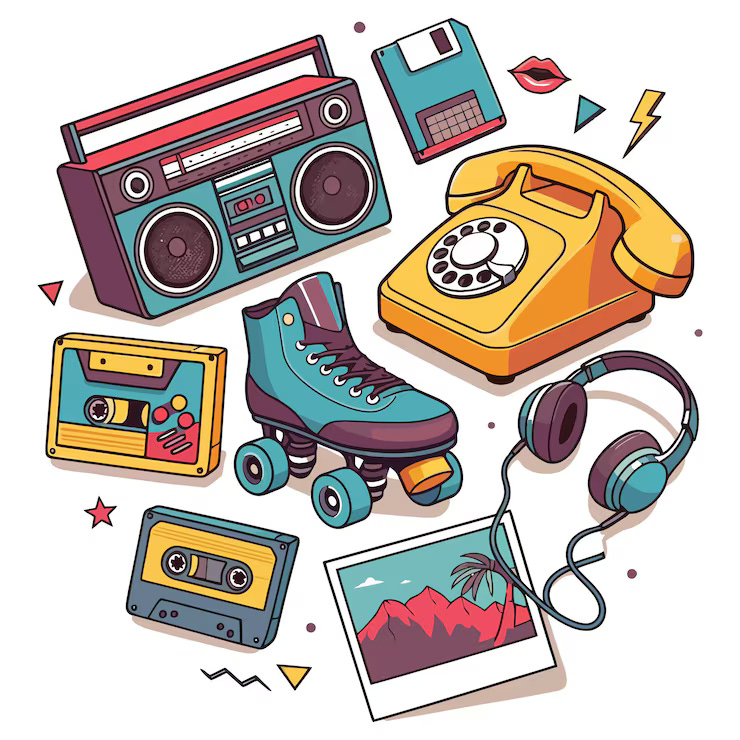
How did we spend our time? Sure, there were TV series, but you didn’t shape your personality around them or spend a hundred episodes glued to a screen. Books and conversations were a great way to pass time. Also silence, and it wasn’t something to escape from.
Typewriters didn’t allow for mistakes. There was correction fluid and correction paper —Tipp-ex—but you didn’t overuse it. Before typing, you would often write your text by hand. Ink ribbons and paper weren’t to be wasted. Later came typewriters with correction features, just before personal computers changed everything.
Music lived on vinyl records and record players, before cassettes and CDs arrived. The more sophisticated models of record players allow you to use batteries, and more freedom for the appliance didn’t need to be plugged. There was the radio, too; we recorded our favorite songs onto cassettes, trying to avoid the ads. Recording a song from the radio meant waiting, timing, paying attention. Now music is infinite, and disposable.
No Spotify, no earbuds sealing you off all day. When the Walkman appeared, it felt revolutionary; though its batteries reminded you that even freedom had limits.
What else did we do in the analog era?
We gathered with friends. We talked—really talked—for hours, without checking a screen every thirty seconds. We got bored. And boredom wasn’t a problem to solve, it was the space where something could begin.
At school, research was done in libraries and using books, not search engines. There were no websites to solve your math exercises or write your essays. We used our brains intensely. Everything was created—handmade, thought through, understood, and developed—without digital shortcuts. If you didn’t understand something, you had to earn understanding. Today, effort is optional. And it shows.
The world felt distant, not constantly present, and wide, vast. You were curious about people and places you wished to visit someday. There was no way to follow everything online, no live broadcasts of bombings, no endless stream of distant events, not immediate news about every word some stupid person pronounced. Now everything is instant, and somehow, everything feels small. Flattened into the same feed. The same tone. The same outrage. You are informed about everything, and connected to nothing.
In the analog era, you lived your own life. Not a curated, optimized, performative version of it. There were no influencers or celebrities displaying their perfect lives and bodies all day long online. You didn’t need a life coach or someone to explain you how to live, what to do of your life, how to think, how to make-up, what to eat, how to solve your traumas (family and friends or a psychologist were usually enough). We didn’t have a wiki to answer every question you could have. Now everything is explained, instantly. And yet very little is understood.
I still remember the first modem connections. That absurd, mechanical noise. It sounded like something breaking. In a way, it was. And before that, the fax machine and personal computers. We entered the digital world slowly. We adapted and kept some of our habits. We still used dictionaries and relied on thought.
Even war has changed, not in its horror, but in its character. War was analog. Soldiers on the ground. No real-time footage of death. No systematic destruction of non-combatants. No drones deciding targets according to skin color. No mass identification of protesters.
At the same time, something else happened quietly in this digital era: your life stopped belonging entirely to you.
We used to worry about governments controlling information. Now we hand it willingly to corporations. There was a time when your data, your life, remained yours. No giant companies harvesting your information. No tech elites trying to shape your choices: what you think, what you see, even who you vote for.
No endless scams. No self-proclaimed experts. No algorithm-fueled outrage. No industrial-scale misinformation. No synthetic intimacy. Now your data is extracted. Your attention is engineered. Your desires are predicted before you can even articulate them.
New generations don’t adapt to technology. They are shaped by it. And now we are entering the next phase: AI. Not a tool. Not just an assistant. A replacement for effort, for judgment, for creation, for people.
You don’t need to write; you just prompt.
You don’t need to think; you just generate.
You don’t need to know; you just ask.
And the more you outsource, the less remains.
Now, we gained speed, access to infinite tools, constant connection, and greater loneliness. Sometimes I wonder if, in losing the limits, we also lost part of the depth.
Analog generations know what it meant to think on our own terms. We didn’t have chatbots to ask about the meaning of life. And even now, we still recognize the value of the human factor, though humanity itself doesn’t always show its best side.
So here’s my question:
If AI or the Internet stopped working tomorrow, what would happen to us? Would you know how to write a page from scratch? To build an argument? To sit with a thought without escaping it?
Or would you feel that quiet panic, the one that comes when you realize the tool was doing more than helping?
Maybe the real divide isn’t between analog and digital. It’s between those who can still function without the machine and those who can’t.
So, tell me, what would you do? Sit outside and rediscover life? Or stare at a blank page, waiting for something else to think for you?
The flow of language, conversation and culture is all moving in a direction impossible to predict.
I do think in 40 years it will be very apparent who has a mind and can still use it. Maybe even 5 years, why wait 40.
Still, it may be unwarranted to scold people for jumping down a chute with billions of other earthlings. They don’t know they have a choice. One foot in front of the other, to oblivion.
Personally, I like thinking and writing with my own squishy brain. Otoh, Claude is a good editor, and is improving my structure. I wish I could afford a human editor, but I can't, so here I am.